
When Barb Bridges’ husband died suddenly in 2014, she says there was no question that she would honor his wishes to be a donor.
At the time, Barb understood that his gifts would make a difference in someone else’s life, but more than a decade later, she came to understand that difference in an unexpected way: Barb became a cornea recipient herself.
“To be the recipient of the same type of donation was really emotional,” she says.
Understanding both sides of the gift
Barb was only 26 years old when her first husband died of cancer in 1978. Years later, she married Fred, who had also lost his first spouse at a young age.
Those experiences, she believes, gave them both a particular sensitivity to loss and to the importance of helping others. Plus, Fred had studied biology in college, and Barb says he decided early on that he wanted to be an eye, organ and tissue donor after his death.
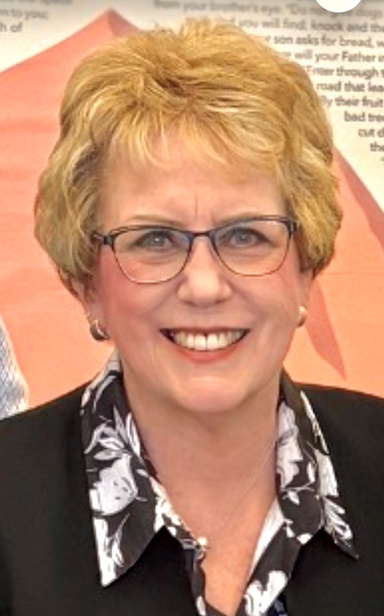
Barb says she has seen how conversations surrounding death and grief have changed over the decades. When her first husband died, she remembers grief as something people often experienced much more quietly. Today, families have more opportunities to talk openly about death, grief, hospice care — and donation.
Barb and Fred had those conversations.
“We decided we wanted to give life and give things back to people who deserved a new chance at life when they had health issues,” she says. Thus, “there was no hesitation when Fred died. We were going to follow his wishes.”
After his death, Fred was able to donate tissues as well as his eyes. Still, Barb says she couldn't fully comprehend what Fred's donation meant to another person — not until she needed something from a donor herself.
A gradual change in sight
Barb grew up in Waverly, leaving for college at Iowa State University and for work elsewhere before eventually returning to her hometown. She has lived in Waverly for about 50 years, now, building a career in banking and then fundraising for a local retirement community. She is the mother of six children and grandmother of 20.
About 10 years ago, Barb says her optometrist noticed early signs of Fuchs dystrophy, a condition that affects the cornea and can gradually cause cloudy or blurred vision. For years, it was simply something to watch.
Barb later learned that Fuchs dystrophy ran in her family. Her older brother also had the condition and underwent a corneal transplant in Minnesota. Eventually, Barb’s own vision deteriorated enough that it was time to consider transplantation herself.
She was initially scheduled for surgery closer to home, but changes at the practice led to the surgery’s cancellation. She was then referred to University of Iowa Health Care Medical Center-University Campus, where she underwent her first cornea transplant early 2026. She eventually received transplants in both eyes.
Barb says first transplant went extremely well, but after surgery on her second eye, she developed a severe retinal problem that required additional surgery and treatment. She continues to receive monthly injections, and vision in that eye remains challenging. But Barb says those retinal complications had nothing to do with her corneal transplants. She says the corneal transplants gave her clearer vision when Fuchs dystrophy was threatening to take it away.
Today, Barb can cross-stitch again, one of her favorite hobbies. She can read, although not for as long as she once could because of her retinal condition. Better vision also helps her maintain her independence and stay involved in the lives and activities of her grandchildren.
“I am very appreciative and grateful that I can see what I can see,” she says.
When eyesight changes, life changes
Before experiencing serious vision problems herself, Barb didn't fully understand how profoundly eyesight affects almost everything a person does.
“Until you are in it, you don’t really get it,” she says. “When you get into a situation where eyesight is challenged and compromised, it’s a huge impact on how you live your life. That’s where the appreciation and gratitude come from, having corneal transplants, because that vision was threatened until I got the cornea transplants, and then I could have better vision.”
For Barb, transplantation also brought something she couldn't have anticipated: a new understanding of the decision her family had made years earlier. Somewhere, another family experienced a loss and donated the corneal tissue that restored Barb’s sight, just as Fred's donation had once helped others.
“I have a full appreciation for not only being on the receiving end,” Barb says, “but what we were able to give.”